Key Levers for the Climate Transition: Incentives, Innovation, and Insurability
October 22, 2026
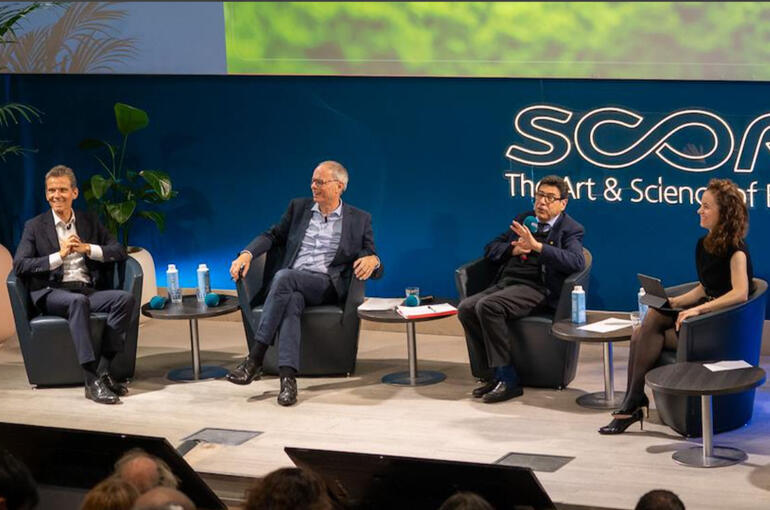
From left to right: Thierry Léger, SCOR’s Chief Executive Officer, Jean Tirole, 2014 Nobel Laureate in Economics; Philippe Aghion, 2025 Nobel Laureate in Economics and Aurélie Dard, SCOR’s Group Head of Sustainability and Public Affairs.
Insights from Economics and Reinsurance
SCOR’s Sustainability Days opened with a panel bringing together Philippe Aghion, 2025 Nobel Laureate in Economics; Jean Tirole, 2014 Nobel Laureate in Economics; and Thierry Léger, SCOR’s Chief Executive Officer. Moderated by Aurélie Dard, SCOR’s Group Head of Sustainability and Public Affairs, the discussion was a frank conversation about the urgency of climate action and how reinsurers can challenge their sustainability strategies to maximize real-world impact.
Combining economic perspectives with the practical experience of the reinsurance industry, the discussion focused on three key questions: the cost of delaying climate action, the policies needed to accelerate the transition, and how insurers and investors can help drive real-world impact.
The Cost of Delay
“Something we must forget about is the myth of green growth…” - Jean Tirole
The panel challenged a comforting assumption: that going green will automatically translate into profits, competitiveness, and economic growth. While green technologies create long-term business opportunities, the transition itself carries real adjustment costs and short-run losses. Jean Tirole warned against the promise of painless “green growth” that understates those trade-offs, emphasizing that “we have something to pay—it’s our moral duty to do it.”
Delaying action will not make these costs disappear; in fact, it risks magnifying them significantly. “Doing nothing is not an option,” Philippe Aghion underscored, noting that “there is a cost of delay, which will take the form of a more prolonged and deeper period of low growth.”
Reinsurers know this well. With resilience at the heart of their role, reinsurers have been raising their voices about global warming and its societal costs since the 1990s. Thierry Léger’s message was thus one of urgency: “Urgency means investing today for a better future.” While acting today carries a real “green premium,” Léger stressed that this is an investment in the future: every dollar spent today will save several dollars down the road. The challenge is that the costs of action today are visible, whereas the far greater costs of inaction are not.
Reinsurance Rethink: Reinsurers can contribute to making the economic costs of climate inaction explicit and, therefore, more visible. By quantifying risk exposure and avoidable financial losses, reinsurers demonstrate the clear economic return of investing in mitigation and adaptation today versus absorbing catastrophic losses tomorrow.
Pricing Carbon, Unlocking Innovation
“Without green innovation, in a broad sense… we won’t successfully fight climate change… It won’t happen just because we reduce consumption.” - Philippe Aghion
Carbon pricing, whether through taxation or emissions trading systems (ETS), ensures that the social cost of carbon is reflected in everyday economic decisions. As Jean Tirole underlined, it “is actually very efficient”: once the price signal is in place, businesses, and consumers are incentivized to adjust behavior and redirect capital towards lower-carbon alternatives, often achieving greater reductions at lower cost than more prescriptive instruments. Carbon pricing also creates the economic conditions for innovation. As Tirole observed, “if you are an innovator, you cannot monetize it [your invention] if people can pollute for free.” By creating a cost for emissions, carbon pricing strengthens demand for innovative low-carbon solutions.
The discussion also acknowledged the challenges associated with carbon pricing, particularly its distributional effects.Participants explored whether insurance-style mechanisms could help cushion the impact of price shocks on vulnerable households and businesses without diluting overall decarbonization incentives.
Yet, carbon pricing alone was not seen as sufficient. Aghion argued that climate policy needs to “use both legs”: carbon pricing to address the environmental externality, alongside a “green industrial policy” to correct the underinvestment in green innovation arising from knowledge externalities, whereby the benefits of innovation often extend far beyond the companies that develop it. While Europe has pushed carbon pricing, notably through the ETS, the United States has leaned more heavily on the “carrot leg” of green industrial policy. For Aghion, the answer is not to choose between the two, but to combine them: “we need the two legs.”
The challenge is then how to design a “green industrial policy.” For Tirole, public support for green innovation is necessary, but it should be carefully targeted. He highlighted two guiding principles: diversify investments without putting “all your eggs in the same basket,” while remaining sufficiently selective to avoid funding initiatives unlikely to succeed; and rely on scientific expertise to identify the most promising technologies, urging policymakers to “get the scientists to pick the winners.”
The panel also stressed the importance of striking the right regulatory balance. Over-regulation can favor incumbents better equipped to navigate its requirements, while creating barriers to entry for new innovators that may hold solutions to the very problems regulation seeks to address. The challenge is therefore to manage risks without stifling innovation.
Reinsurance Rethink: Innovation cannot scale without insurability. By developing specialized underwriting expertise for novel green technologies, reinsurers can help turn first-of-a-kind clean tech ventures into bankable, investable risks.
From Greening Portfolios to Driving Real-World Transition
“It’s going to be a lot of little drops that make the river and then the sea…” - Thierry Léger
Thierry Léger reflected on the role of companies in driving the sustainability transition. Through concrete decisions on investment, innovation, and operations, individual corporate actions can collectively build the momentum required for systemic change.
While financial institutions frequently focus on “greening” their portfolios, including, for reinsurers, both underwriting and investment portfolios, the panel urged companies to ask a deeper question: are portfolio changes actively reducing real-world emissions, or simply improving the firm’s green metrics? As Tirole put it, “The issue is, do we change anything? … We want to be effective in fighting climate change and have actions that pay off.” Ultimately, effective climate action should be measured by real-world impact, not portfolio metrics alone.
This distinction is critical when evaluating exclusion policies. Exclusions of carbon-intensive activities can play a useful role, but their real-world impact will depend in part on the broader market context. In the absence of market-wide coordination, excluded activities may simply shift to other insurance or capital providers, without necessarily reducing emissions. Exclusion can also entail a trade-off: once an insurer withdraws from a company, it has less scope to use its underwriting capacity, investments and influence to support and incentivize that company’s transition. The question, therefore, is where exclusions are most effective and where greater progress can be achieved by incentivizing clients to implement credible transition plans, particularly in an increasingly fragmented world.
The discussion also highlighted the risk of a “middle-transition trap,” whereby support for intermediate solutions can deliver short-term progress while inadvertently delaying the deployment of more transformative technologies. Philippe Aghion suggested that financial institutions can help mitigate this risk by attaching conditions to financing, investment, or insurance support, for example by requiring a share of the revenue generated to be reinvested in low-carbon innovation and R&D. In this way, underwriting and investment can become tools for accelerating the transition.
Reinsurance Rethink: The ultimate measure of corporate sustainability is not whether an activity is green today, but whether engagement through investment or underwriting creates credible incentives for it to become greener tomorrow. In that sense, transition-linked investment and insurance solutions may be able to deliver greater real-world impact than outright divestment or withdrawal of coverage.
A Pragmatic Case for Optimism
When asked what could drive a successful transition over the next decade, the three speakers pointed to complementary sources of progress. Philippe Aghion highlighted breakthroughs in clean energy and the potential of “virtuous” AI. Jean Tirole emphasized the importance of prevention and highlighted the role of scientific expertise. Thierry Léger stressed the cumulative impact of positive individual corporate decisions. Across all three perspectives, optimism rested less on the idea of an easy transition and more on our ability to align incentives, accelerate innovation, and use insurance and reinsurance to build a more resilient economy and society.