
Sustainability in our Activities
We integrate sustainability considerations across all our activities:

Underwriting activities
At SCOR, sustainability is embedded in our core business as a global reinsurer. Through our Property & Casualty and Life & Health activities, we support clients and societies in understanding, managing, and adapting to evolving environmental, societal, and health-related risks.
By integrating sustainability considerations into our underwriting, risk expertise, and client engagement, we help to strengthen resilience, reduce protection gaps, and support the transition to a more sustainable future.
Principles for Sustainable Insurance
As a founding signatory of the United Nations Principles for Sustainable Insurance (PSI), SCOR actively contributes to advancing sustainable insurance practices across the industry. Through our participation in UNEP FI working groups on Nature, Climate Resilience, and Social Sustainability, we collaborate with peers and stakeholders to share expertise and promote the integration of environmental, social, and governance considerations into underwriting, risk management, and insurance solutions. We believe collaboration is essential to address complex sustainability challenges and to strengthen the resilience of societies and economies.
P&C (re)insurance




(1) Climate-related ambitions and targets are dependent on a number of external factors beyond SCOR's control, including government policies, technological developments, market conditions, regulatory changes, climate science developments and the pace of economy-wide decarbonization.
(2) References to a 1.5°C pathway relate to internationally recognized climate scenarios and scientific assessments aimed at limiting the increase in global average temperatures to 1.5°C above pre-industrial levels.
Life & Health
Our approach
SCOR aims to benefit the lives of individuals and improve the resilience of societies. Our Life & Health business supports clients in developing inclusive products to reduce the protection gap, works on innovative prevention solutions to help policyholders live healthier and longer lives, and draws on robust biometric research to design tailor-made solutions adapted to medical and demographic trends.

Knowledge and research
SCOR is actively engaged in numerous research and business partnerships to explore ways to make life insurance more relevant and expand protection. The insights gained are shared widely through publications and presentations.


Investment activities
At SCOR, sustainability is not just about building a resilient portfolio. It is a powerful lever to anticipate risks, create long-term value, and contribute to a more sustainable future.
We are convinced that sustainable investing strengthens our ability to navigate an evolving world while delivering superior long-term returns. This conviction is embedded in our Sustainability Policy (Open in new window), which integrates environmental, social, and governance (ESG) considerations across all investment decisions.
Sustainable Investing Principles
Building a resilient future
SCOR seeks to contribute to international climate and biodiversity objectives, notably those set out in the Paris Agreement and the Kunming-Montreal Global Biodiversity Framework (GBF). As an institutional investor, SCOR aims to play its part by limiting negative environmental impacts through responsible investment practices, while increasing the positive impact of its portfolio by selectively financing climate and nature-based solutions. This table summarizes SCOR’s high-level investment Theory of Change, linking objectives, actions and outcomes to the environmental impacts these efforts are designed to support.
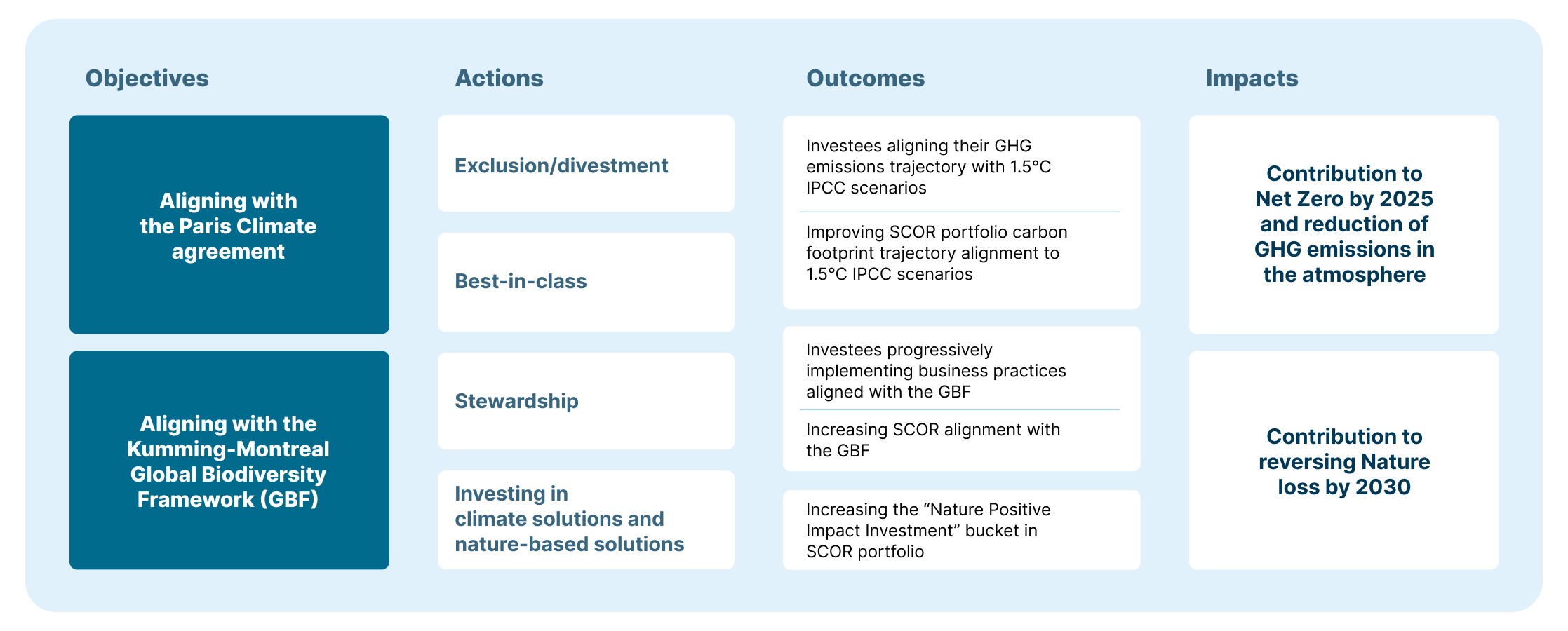
SCOR is a signatory of the United Nations Principles for Responsible Investment (PRI) and the United Nations Principles for Sustainable Insurance (PSI). We actively promote these principles throughout our value chain and work with our partners to accelerate their implementation.
We champion strong governance, integrity, accountability, and the sharing of knowledge and expertise. Our commitment also extends to shaping the broader sustainable finance agenda. From 2018 to 2020, we were proud to contribute to the European Commission's Technical Expert Group on Sustainable Finance, helping advance the development of the EU sustainable finance framework.
SCOR's Investments
In our investment decisions, SCOR relies on the ESG expertise and engagement of our investment managers to select securities that integrate ESG criteria.
Figures as at December 31, 2025

Climate Change
At SCOR, our commitment to the Paris Agreement is more than an ambition. It is a guiding principle that shapes how we invest, manage risk, and create long-term value.
Drawing on our deep expertise in climate risk, we continuously assess how climate change could affect our investment portfolios and take action to strengthen their resilience. At the same time, we recognize that investment decisions also have an impact on the environment. This is why we carefully evaluate how our portfolios interact with and influence the planet's ecosystems.
We are committed to supporting the transition to a low-carbon economy, directing a significant share of our investments toward solutions that contribute to this transformation. In line with this commitment, we have set the ambition of achieving net-zero emissions by 2050.
The transition to a more sustainable economy presents both challenges and opportunities. We focus on two key categories of climate-related risks:
Rather than viewing these developments solely through a risk lens, we also seek to identify the opportunities they create. Innovation, new technologies, and the accelerating transition to a low-carbon economy can unlock attractive long-term investment opportunities and are an integral part of our sustainable investment strategy.
Negative Screening: Exclusions
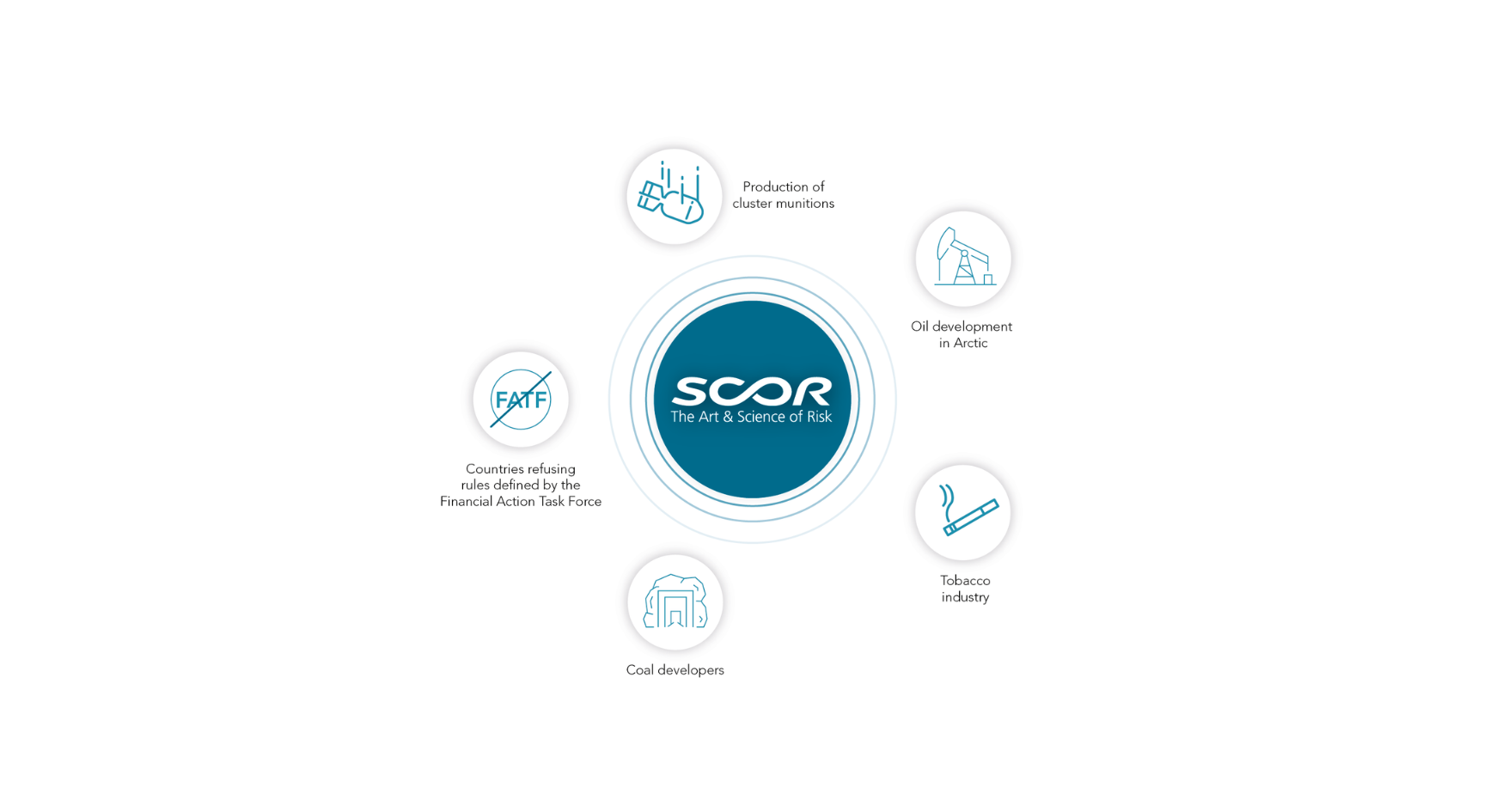
In line with the Group's engagements on climate change, biodiversity, and the sustainable development of society, some activities or issuers are excluded from SCOR's investment universe. Details of such exclusions can be found in our Sustainability Policy (Open in new window).

Sustainable Operations
Our approach
At SCOR, Sustainability is not only embedded in our activities; it also guides the way we operate. We believe that leading by example is key to delivering on our ambition and creating long-term value for all our stakeholders.
From managing our buildings and energy consumption to business travel, employee commuting, mobility, and procurement, we continuously seek to reduce our environmental footprint and promote responsible practices across our value chain. We also actively engage our employees, recognizing that their involvement is essential to achieving our sustainability objectives.
By integrating sustainability into our day-to-day operations, we contribute to our net-zero journey while fostering a culture of responsibility, learning, and continuous improvement.
Reducing our environmental footprint
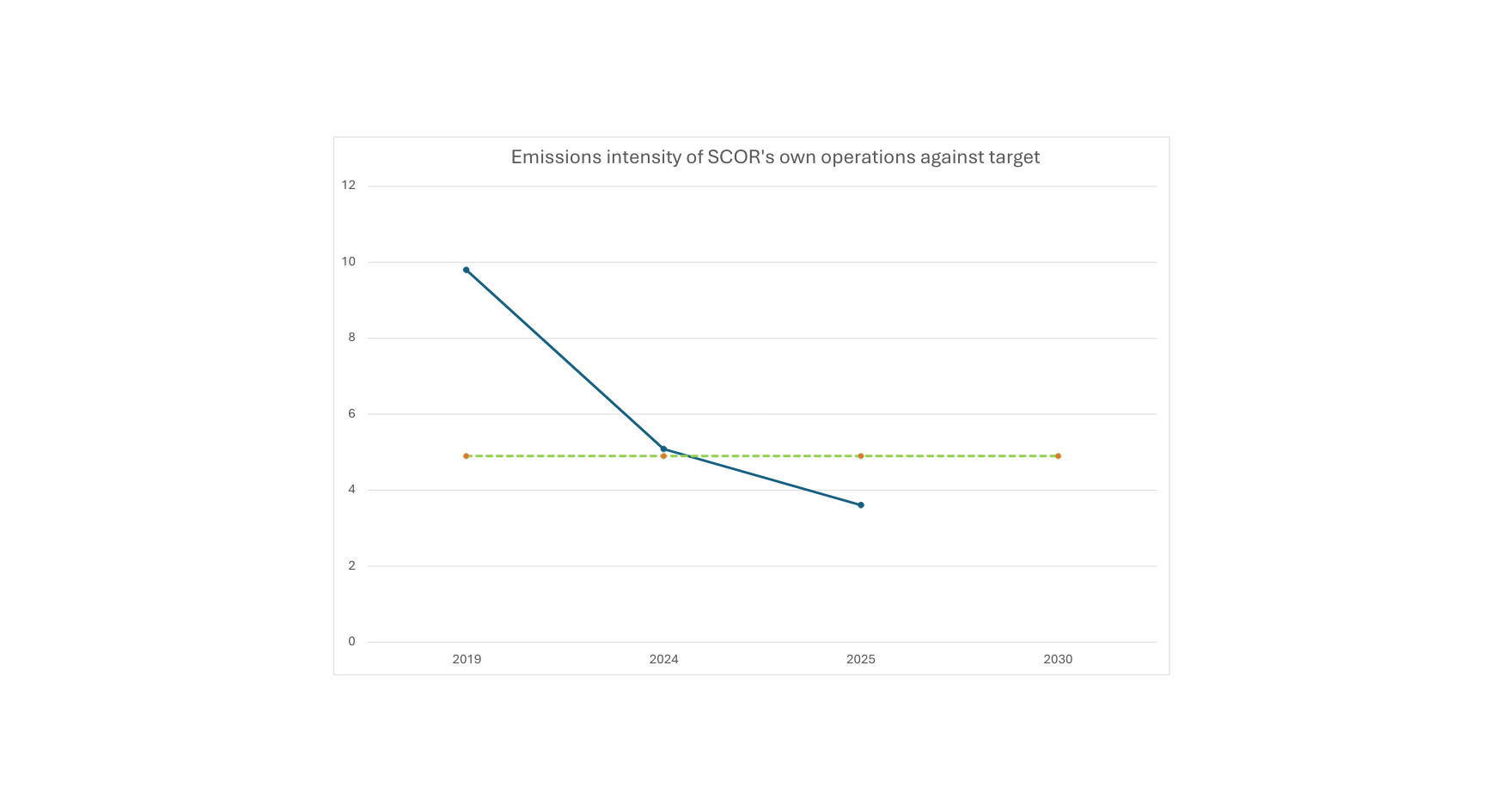
As a company with sustainability at the core of its strategy, SCOR is committed to reducing the environmental impact of its operations through ambitious actions and transparent performance monitoring.
Looking ahead, we aim to transition our activities to net zero by 2050. As an important milestone on this journey, the Group targets a 50% reduction in carbon emissions intensity per employee by 2030, compared with 2019.
Our strategy rests on two pillars:
- Addressing residual emissions that can’t yet be avoided, by supporting high-quality carbon projects that deliver measurable climate benefits and contribute to the global transition to a low-carbon economy. As part of this, we offset 100% of our reported GHG emissions on own operations.
- Reducing emissions at source, through energy efficiency initiatives, increased use of renewable electricity, and more sustainable ways of working worldwide.
Embedding Sustainability in our supply chain
SCOR seeks to embed responsible practices throughout its supply chain. Through our Sustainable Development Charter (Open in new window), we set clear expectations for suppliers on environmental, social, and governance matters. By promoting alignment with internationally recognized standards, we help foster responsible business conduct and support positive environmental and social outcomes across our supply chain.