Talent in Transition
November 17, 2026
Why Curiosity, Adaptability, and Human Connections Will Shape the Future of Work
In a world being transformed by artificial intelligence and constant innovation, success will belong to those who stay curious, embrace change, and continuously reinvent themselves.
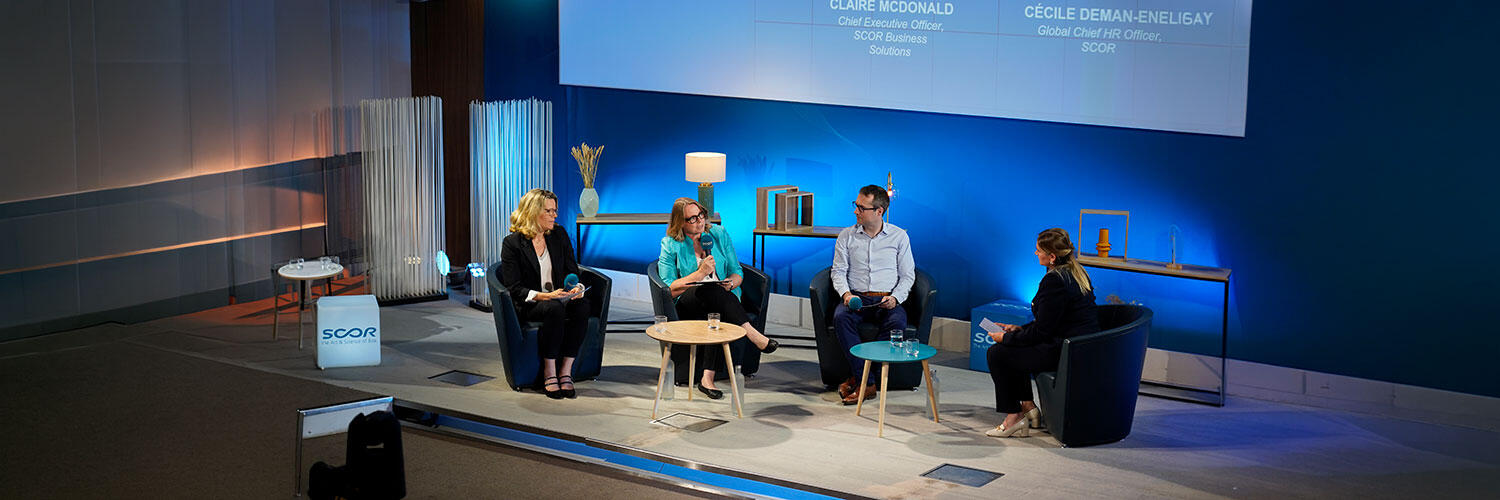
That was the key message from the "Talent in Transition" panel at SCOR's Employer Brand Campaign event, where Cécile Deman-Enel (Chief Human Resources Officer), Claire McDonald (Head of SCOR Business Solutions), and Thibault Antoine (Chief AI Officer) shared their perspectives on how professionals can prepare for a rapidly changing workforce and what skills will matter most in the years ahead.
Change is rarely a surprise. Our response is what matters.
Opening the discussion, the panel reflected on the disruptions that have shaped their careers and the lessons they've taken from them.
For Claire, the biggest lesson is that major changes are often visible long before they arrive.
"We know it's coming, but how well we embrace it is another factor."
Whether discussing COVID-19 or the rise of AI, she argued that organizations and individuals usually receive enough signals to anticipate change. The real challenge lies in choosing whether to engage with it or resist it.
For Thibault, the pandemic offered a powerful example of adaptation in action. Although his background was not in epidemiology, he suddenly found himself helping develop pandemic-related models during one of the most uncertain periods in recent history.
The experience reinforced several principles that continue to guide his work today: building diverse teams, learning quickly, and collaborating across disciplines.
"We had to collaborate extensively," he explained, highlighting how experts from medicine, actuarial science, underwriting, and data analytics worked together to tackle an entirely new challenge.
Meanwhile, Cécile pointed to a different transformation: the explosion of data and information surrounding us every day.
Twenty years ago, she could not have imagined a world where news, insights, and opinions arrive every minute. As a result, she believes skills such as critical thinking, information analysis, and the ability to step back and reflect have become more important than ever.
The skills that technology cannot replace
While AI dominated much of the discussion, the panelists repeatedly emphasized that technical tools alone will not determine future success.
According to Cécile, technical skills remain essential, but knowledge is now more accessible than ever. What sets people apart is their ability to learn continuously, think critically, and remain curious.
Claire agreed, emphasizing the importance of interpersonal relationships and creativity: "Technology is not going to replace interpersonal relationships."
She noted that while AI can accelerate processes and support decision-making, innovation still comes from bringing diverse people together and harnessing their collective creativity.
For Thibault, whose job centers around how to empower employees to make the most of AI tools, AI should not be viewed as a threat but as an amplifier of human expertise.
"AI is not going to replace people. AI is going to amplify people."
Those who continue developing deep expertise in their chosen fields will be best positioned to benefit from new technologies and create greater impact.
Experiment now, don't wait for perfection
Perfection is the enemy of progress – even in the age of AI. As AI capabilities evolve rapidly, Thibault encouraged employees not to wait until everything feels fully mature.
His advice was simple: start experimenting now. Regularly ask yourself how AI can help you work faster, work differently, or achieve better results. Waiting for perfect conditions, he argued, means risking falling behind.
Claire added that employees do not need to navigate these changes alone. Speaking with colleagues, learning from those who are already exploring new tools and sharing knowledge across teams can make the transition far less overwhelming.
At SCOR, examples of this learning mindset are already emerging. The panel shared stories of employees developing their own AI-powered tools, exchanging ideas across functions, and embracing opportunities to rethink the way they work.
The rise of the hybrid professional
Looking ahead, the panelists believe career paths will become less linear and more dynamic.
Thibault expects to see increasing demand for hybrid profiles: professionals who combine business expertise with an understanding of data and technology.
Rather than following traditional vertical career paths, future professionals may move between functions, gaining new experiences and perspectives along the way.
At the same time, Cécile stressed that there will continue to be opportunities for professionals at every stage of their careers.
While some tasks may become automated, expertise, judgment, adaptability, and collaboration will remain critical. The goal is not replacing people but creating environments where junior, mid-career, and senior professionals can work together and learn from one another.
Why reinsurance remains uniquely exciting
The discussion also explored what makes the reinsurance industry distinctive in an era of rapid change.
For Claire, reinsurance will always require a balance between technical excellence and strong relationships. While technology can help deliver better analysis and faster service, trust, credibility, and customer relationships remain essential.
Thibault highlighted the industry's unique combination of expertise, data, technology, and rapid decision-making.
Meanwhile, Cécile pointed to SCOR's strong connections with research institutions and its constant focus on anticipating future risks.
"A large part of our time and our discussions are about anticipation."
That combination of science, innovation, and forward thinking makes reinsurance an especially stimulating environment for professionals looking to build future-ready careers.
The full event replay is available on LinkedIn.